Summary:The technology of artificially synthesizing fragrances can be mainly divided into semi synthetic and total synthetic methods. The semi synthetic method mainly extracts natural plant essential oils and produces products through chemical reactions. The source of raw materials limits the production scale of natural extracts. The chemical total synthesis method synthesizes products from petrochemical raw materials, with a wide range of raw material sources, abundant downstream products, low costs, and certain competitive advantages.
Chemical semi synthesis: based on three major raw materials, limited production scale
Chemical semi synthetic fragrances are mainly prepared by starting from isolated fragrances to produce various fragrance derivatives. At present, chemical semi synthetic fragrances are mainly synthesized through various products such as clove oil, guaiacol oil, lemongrass oil, turpentine (pinene), and camphor oil to produce a rich range of fragrance products. The following will mainly introduce the chemical semi synthetic fragrance industry chain of clove oil, lemongrass oil, and pinene.
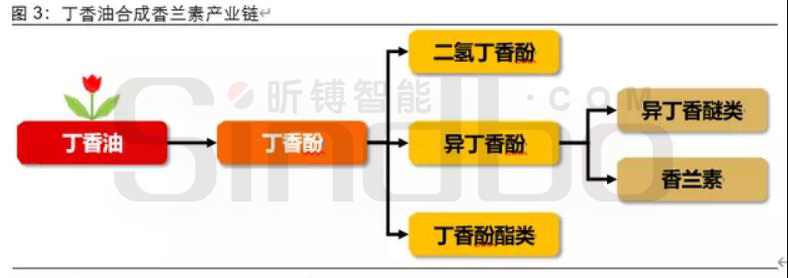
Lilac oil: synthetic bulk spice vanillin. Lilac oil (extract from clove stem) extracts natural eugenol, and the quality of vanilla synthesized from eugenol is close to that of natural products, which is widely favored in the high-end food and beverage market. However, the production of vanillin from raw materials such as clove oil and lignin will emit a large amount of pollutants and face significant environmental pressure. Eugenol can be synthesized into dihydroeugenol, isoeugenol, vanillin, and eugenol ester products.
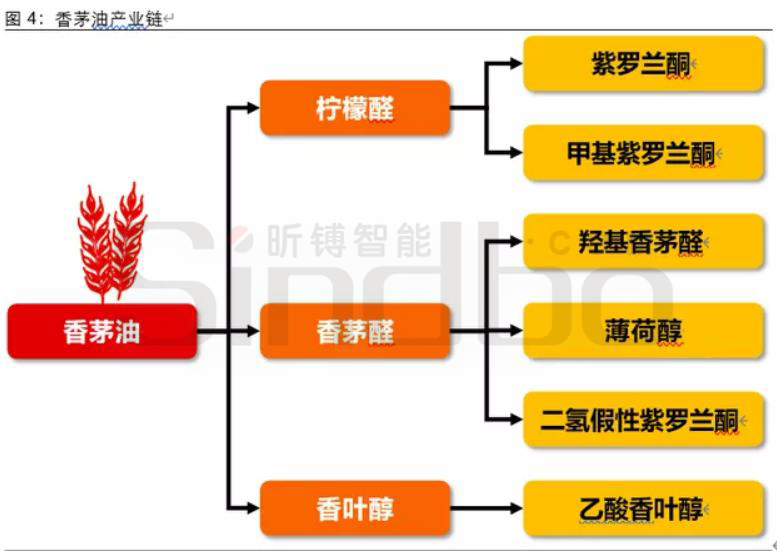
Lemongrass oil: a widely used raw material. Lemongrass oil is an essential oil extracted from lemongrass, which is mainly grown in Latin America and India. The product is widely used in the daily chemical industry. Lemongrass aldehyde is the main component of lemongrass oil, naturally occurring in lemongrass oil and used for the synthesis of more versatile fragrances such as geraniol and L-menthol. The essence and fragrance prepared from citronella oil are widely used in household care products, detergents and other products due to their mosquito repellency.
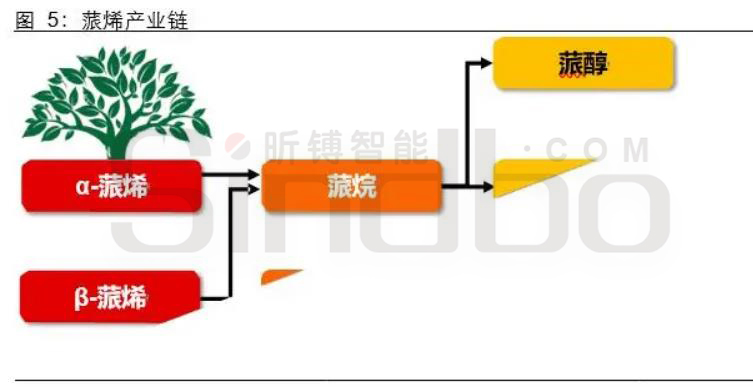
Pinene: Downstream demand in the industrial chain is concentrated on vanillin and citral. Pinene exists in natural turpentine, with an annual production of around 300000 tons worldwide. Pinene mainly exists in two isomers, alpha and beta. The annual production of pinene in the world is more than 90000 tons, which is mainly used to synthesize a variety of bulk essence such as linalool, geraniol, citral, etc. Due to the fact that natural turpentine is mainly extracted from pine resin, natural production is limited, and the supply of natural semi synthetic market is still tight.
Overall, chemical semi synthetic spice products are limited by limited raw material sources, and their production is usually low, which cannot fully meet market demand. However, chemically semi synthetic spice products usually result in purer spice products, produce fewer isomers of spices, and have product quality closer to natural products, which is to some extent popular in the market.
Chemical total synthesis: based on petrochemical raw materials, producing diversified products
Chemical fully synthetic fragrances are mainly synthesized from petroleum and coal tar based raw materials through chemical processes. Various fragrance products are mainly synthesized through acetylene/acetone, cresol, isoprene, toluene, benzene, acetylene/acetone, and cresol. The following mainly introduces the industrial chain of synthesizing fragrances from isoprene, toluene, and benzene.
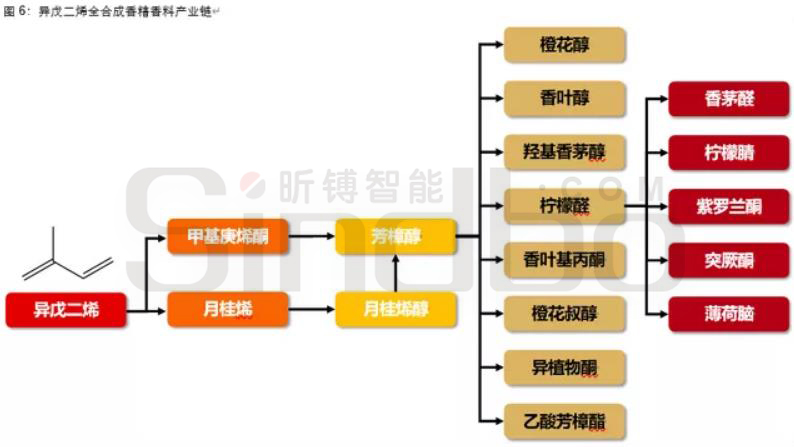
Isoprene: Rich in products and high in synthetic barriers. Isoprene is an important bulk petrochemical raw material and one of the most important products in cracking C5 fractions. The production capacity of isoprene from petroleum has a certain scale. The supply of essence and fragrance from isoprene is guaranteed, and the cost of raw materials is low. Through isoprene, citral, linalool, citronellal, geraniol, menthol and other bulk essence can be synthesized, and the downstream application prospect is broad. The process of synthesizing linalool and citral through isoprene involves multiple steps, with complex product structures and high production barriers, which are only mastered by a few enterprises.
Toluene: With abundant sources of raw materials, it synthesizes highly efficient antibacterial spice cinnamaldehyde. Toluene is also one of the commonly used bulk raw materials with abundant sources. At present, toluene can be used to synthesize the important bulk spice cinnamaldehyde, which has antibacterial, disinfectant, and preservative functions, and can also serve as a physical preservative. Benefiting from the increased consumption of packaged food and organic food essence raw materials, the demand for cinnamaldehyde rose rapidly. According to Bai Liao Hui's prediction, the global cinnamaldehyde market is expected to exceed 2 billion US dollars by 2024.
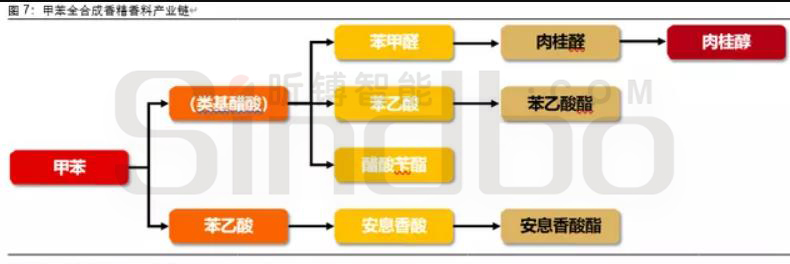
Benzene: synthetic bulk spice benzaldehyde. Benzene can be used to synthesize a large amount of commonly used perfume β - phenylethanol. At present, β - phenylethanol is commonly used to prepare rose essence, and the global production of β - phenylethanol is about 10000 tons. Phenylethanol has a lower price than linalool and is often used in the preparation of daily chemical fragrances. Due to the carcinogenic effect of the raw material styrene, the synthesis of β - phenylethanol is mainly used as a fragrance for daily chemical products, and current research is mostly focused on the synthesis of β - phenylethanol using biological fermentation methods.
The diversification of the synthetic fragrance industry chain structure and high technological barriers have created an excellent track for the synthetic fragrance industry.
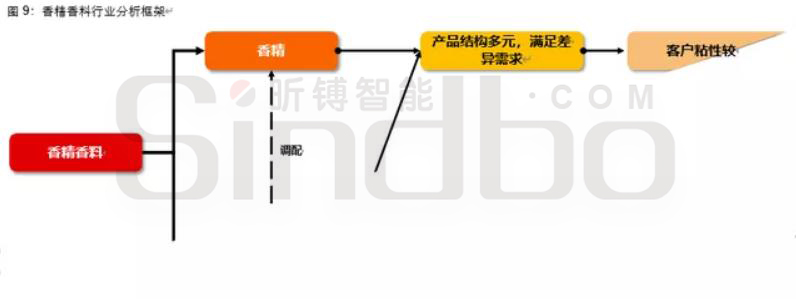
There are various types of spice products with complex product structures, and different products cannot be completely replaced. The spice product market meets diversified characteristics.
Essence needs a variety of spices for preparation. Different essence products can meet the differentiated needs with strong stickiness. essence products also meet the diversified characteristics.
The barrier to entry for synthetic spice technology is high, and leading enterprises have exclusive control over the synthesis process and formula, with strong discourse power. The following will analyze the supply and demand of essence and fragrance industry, and deconstruct the growth and competition pattern of the industry.



 Tel:
Tel:
 Phone:
 Email:
 Addr:
Addr:
 Follow: