Summary:Essence and fragrance industry is a sub industry of special chemicals. This section combs the characteristics of essence and fragrance industry chain, and finds that the synthetic flavor industry has a diversified product structure, which can meet differentiated needs and has high customer stickiness; The high barriers to entry in the synthesis process of the industry contribute to the formation of an oligopolistic monopoly pattern, making it an excellent track.
mainly synthetic essence and spices, with rich varieties
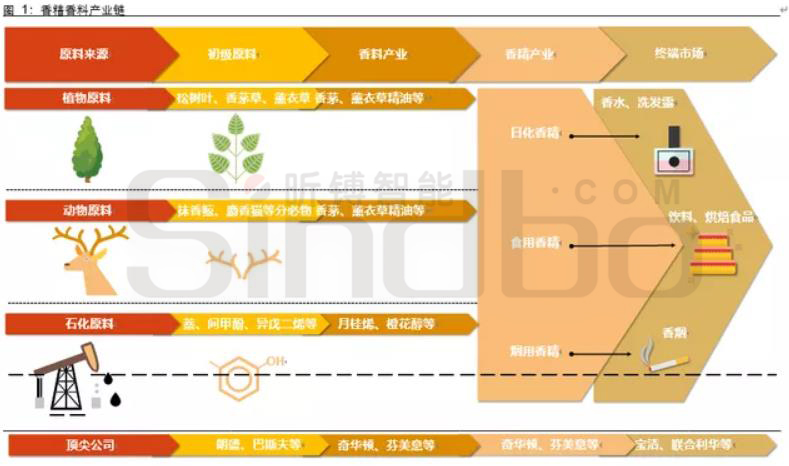
The product structure of essence and spice kingdom is diversified. Spices are compounds that can bring flavor and are raw materials for preparing essence, while essence is a mixture of a variety of spices. The relationship between the two is inseparable. Essence and spice products are widely used in food, daily chemicals, tobacco and other fields. After hundreds of years of development, the world has formed a complete industrial chain of essence and flavor production from plant, animal extracts and petrochemical raw materials. According to their sources, spices are divided into natural spices and artificially synthesized spices.
Natural flavors: including plant flavors (lemongrass essential oil, lemon essential oil, rose essential oil, etc.) and animal flavors (ambergris, beaver, civet, etc.). Natural flavors have limited sources of raw materials and are relatively expensive, but they are closer to natural flavors.
Artificially synthesized fragrances: synthesized from basic petrochemical products such as benzene, toluene, and isoprene, with a wide range of raw material sources and low production costs.
The essence can be obtained after the spices are mixed by the perfumers, so as to be used in the terminal consumer market. According to different use scenarios, essence can also be divided into edible essence, daily chemical essence, etc.
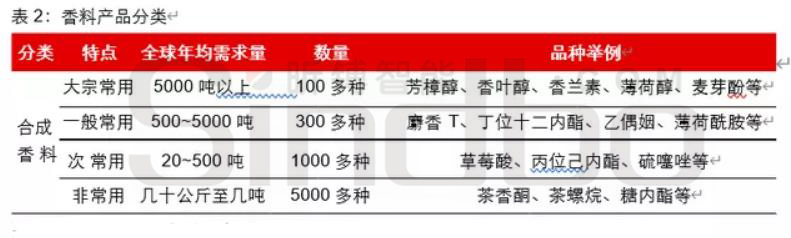
The variety of synthetic spice products is abundant, and their market share continues to expand. At present, there are only about 500 natural spice products worldwide, while there are over 6000 synthetic spice varieties, which are more diverse and can better meet downstream demand. Synthetic essence has the advantages of low cost, safety and large output, and occupies 70%~90% of the global flavor market share. With the rapid growth of market demand, the source of natural flavor is limited and can not fully meet the market demand, and the proportion of synthetic flavor is expected to continue to expand in the future.
There are various types of synthetic spices to meet the differentiated needs of the market. In synthetic spice products, there are more than 100 commonly used spice varieties with an annual demand of over 5000 tons worldwide, mainly including vanillin, linalool, geraniol, β - phenylethanol, menthol, and maltol. There are a wide range of synthetic flavor products, which can meet the demand for differentiated blending of essence products.
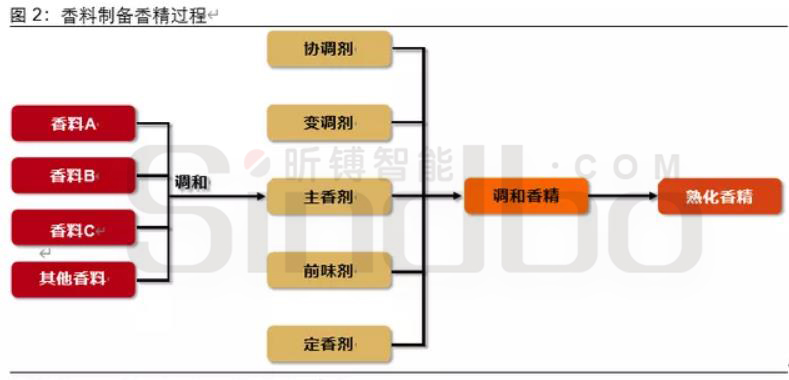
The preparation process of essence is complex, and the flavor mixing process varies greatly. Flavor products have a strong and monotonous taste, which cannot be used directly alone. They can only be used after being mixed and prepared into essence. Essence is usually made from several hundreds of flavors, with a certain flavor type. After blending, essence can be blended by adding a coordinator, a modifier, a flavoring agent and a fixative to form a blended essence, which can be dissolved in water and oil after ripening to prepare a liquid flavor, or dispersed in dextrin and lactose to prepare a solid flavor. According to the prediction of IAL Consultants, in 2014, the global essence market accounted for 51.5%, and the spice market accounted for 48.5%. Generally, a essence product involves the deployment of more than ten or even dozens of flavor products. According to the proportion of flavor formulas and ingredients, essence will have a large difference in flavor and quality, and some products will be more diversified.
In short, essence and spice can be divided into essence and spice, with market share close to 50%, while spice can be divided into natural flavor and synthetic flavor. There are a wide variety of synthetic spice products with diverse product structures, which can better meet downstream demand and account for over 70% of the spice market share. The process of blending essence involves a variety of spices. The blending formula is more differentiated and diversified. Essence and spice products are diversified, which can meet customers' differentiated needs and improve customer stickiness.



 Tel:
Tel:
 Phone:
 Email:
 Addr:
Addr:
 Follow: