According to the different sources and preparation processes of spices, they can be divided into natural spices, synthetic spices, etc. Among them, natural spices are made from the aromatic parts of animals and plants as raw materials, and are processed into original fragrant materials through simple processing. Their forms mostly retain some of the inherent appearance characteristics of plants, such as fragrant wood blocks, fragrant wood slices, etc; Alternatively, aromatic substances can be separated from natural raw materials using physical methods such as steam distillation, extraction, and pressing. Their forms often include essential oils, extracts, purified oils, fragrances, and tinctures, such as rose oil, jasmine extract, vanilla tincture, white orchid resin, turmeric resin, and water fairy purified oil; The advantage of natural flavors is that the main ingredients come from nature, which is relatively in line with the concept of health. The product has a rich variety of flavors, but due to natural conditions, the quantity is limited and the price is relatively high. Synthetic flavors are created by humans imitating natural flavors through their own scientific and technological mastery. A certain "monolithic" spice prepared or created through chemical or biosynthetic pathways using different raw materials; The advantage of synthetic spices is that they have a wide range of raw material sources and a wider variety of product categories compared to natural spices. The disadvantage is that they have a single taste level and require combination and blending for use. Natural flavors are mainly produced by physical methods, while synthetic flavors are mainly produced by chemical or biosynthetic methods. The production processes between the two flavors are completely different.
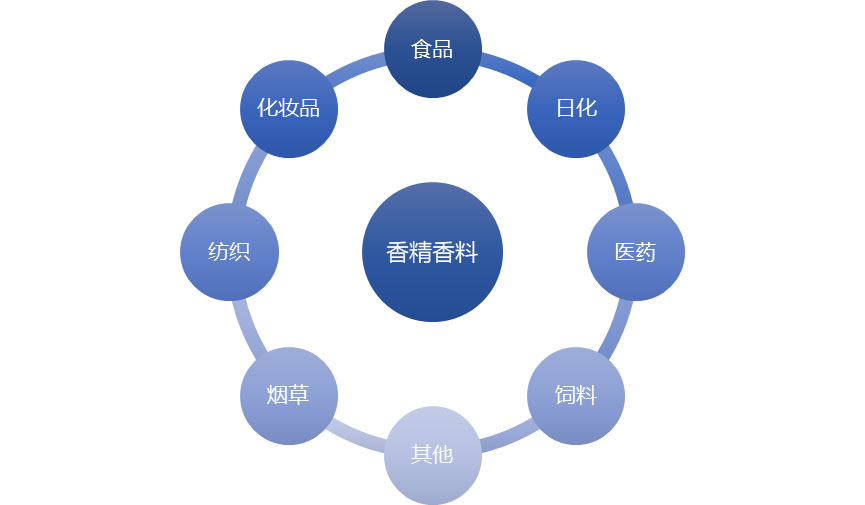
Essence can be divided into edible essence (used for flavoring various foods and beverages for human beings), daily essence (used for flavoring cosmetics, washing products, oral cleaning products and other daily chemical products), feed essence (used for flavoring various animal feeds), and other essence (used for flavoring other industrial products such as plastics, coatings, textiles, etc.) according to their uses and application fields.
Essence and spice industry is an important raw material supporting industry in food, daily chemicals, medicine, feed and other industries in the national economy. It is closely related to the improvement of people's living standards and the development of downstream industries. It is an indispensable important raw material for high-quality life in modern society. In recent years, with the development of global economy and the vigorous development of food, daily chemical, pharmaceutical, textile and leather industries, their demand for essence and fragrance is increasing, and the market size of essence and fragrance is also growing.
2. Development trend of essence and fragrance industry
(1) The safety of essence and flavor products will be the focus of users
Essence and fragrances are mainly used in food, beverage, daily chemicals and other products. They have close contact with consumers and are closely related to the daily life of the people.
In the daily supervision, the supervision department paid great attention to the safety of essence and flavor products. All countries have clear restrictions on the types and dosage of edible essence. In recent years, the supervision of essence and fragrances used in food, beverages and daily chemicals has also been strengthened by listing the prohibited list, and the list has been updated. Producers will also be more cautious about the research and development of new essence and flavor varieties, and ensure that the new products developed can meet the requirements of laws and regulations and market demand through longer research and development cycles and more comprehensive safety tests.
(2) Concentration of essence and spice industry will gradually increase
Limited by technology and talents, the concentration of essence and fragrance industry in China is relatively low. After years of rapid development, China's essence and fragrance industry has emerged a number of professional essence and fragrance production enterprises. Some key enterprises have developed rapidly and actively participated in global market competition. Enterprises with certain influence in the industry are accelerating their growth and expansion through joint ventures, mergers and acquisitions, restructuring, or the assistance of the capital market. The increase in industry concentration will become the future development trend of the domestic market.
(3) Emerging markets have become the driving force for industry development
Due to the unsynchronized development of the global economy, the essence and spice markets in different regions are also different. In regions such as Western Europe and North America that have taken the lead in development, the food and daily chemical industries have entered a highly developed stage, with a wide variety of products and high per capita consumption, but insufficient growth momentum. Although Asia, Africa, Eastern Europe and other regions started late, their economies developed rapidly. With the increase of population and per capita income, the demand for food and daily chemical products grew day by day, driving the development of essence and fragrance industry. Therefore, emerging markets have become the main driving force for the development of the global essence and spice market.
In addition, consumers in different regions have different tastes for essence and spice products due to environmental, cultural and historical reasons. The local essence and spice manufacturers in emerging markets can rely on their knowledge of local consumers' taste preferences to launch more popular formulas, which may seize the development opportunity and change the market pattern of essence and spice to a certain extent.
(4) The market competition is becoming increasingly fierce
The essence and fragrance industry is highly open and the market competition is fierce. Internationally renowned essence and fragrance manufacturers can often lead the formulation of industry standards and the development direction of new products by virtue of their long-standing brand advantages, strong technical accumulation, advanced production equipment, good product quality and standardized business philosophy. At the same time, domestic enterprises are accelerating their participation in international market competition and cooperation by leveraging their accumulated production experience, talent reserves, and domestic cost advantages in recent years. At present, a group of local enterprises with international influence have emerged in China. Through continuous investment and pursuit of production technology and product quality, their brand awareness in the international market has gradually formed, and their influence is increasing day by day. The increasingly fierce competition pattern of the global essence and spice market will be.
3. Industry technical level and characteristics
With the economic globalization, the continuous growth of the domestic economy and the gradual improvement of living standards, the global essence and fragrance layout has also undergone profound changes. The demand for essence and fragrance industry in developing countries has gradually increased, and the potential for Asian market growth has significantly increased. At present, the markets of western Europe, the United States, Japan and other developed countries are approaching saturation, and the sales focus of essence and spices is gradually shifting to developing countries. The world's top ten essence and fragrance enterprises have built factories in China with their accumulated production technology and process, rich marketing management experience and support from R&D centers.
In recent years, the essence and fragrance industry in China has made great progress, and a number of professional production enterprises have emerged. The production and R&D level has improved accordingly, and the gap with the counterparts in developed countries is gradually narrowing. In the spice industry, this trend is more pronounced; Some advantageous enterprises have achieved international advanced levels in terms of process, technology, production equipment, analysis and testing equipment, product quality, and raw material selection and matching through technological transformation and process optimization of traditional spice products, forming batch quantification and large-scale production.
The extraction methods of natural flavors generally include traditional extraction techniques such as steam distillation, extraction, pressing, adsorption, new extraction techniques such as water diffusion, supercritical CO2 extraction, microcapsule two-phase extraction, molecular distillation, etc. The specific method used depends on the properties of the raw materials and the purpose of the flavors. The production of synthetic spices is not limited by natural conditions, resulting in stable product quality. Moreover, many spice products have unique aromas that do not exist in nature, leading to rapid development.
With the progress of modern science and technology, many advanced analytical and testing technologies have been applied in the essence and flavor industry, such as the application of precision analytical methods and structural analysis technologies such as mass spectrometry, chromatography-mass spectrometry, nuclear magnetic resonance, infrared absorption spectroscopy, atomic spectroscopy, X-ray diffraction, etc., which have analyzed the chemical structures of aroma components in many natural flavors, providing a basis for the synthesis of these aroma substances.
The advancement of organic synthesis technology and the development of the petrochemical industry have provided broader prospects for the development of spice synthesis. Currently, with the gradual scarcity of natural spice resources, a large number of spice products have been synthesized using petrochemical products as raw materials. Synthetic spices based on petrochemical and coal chemical raw materials have become an important symbol of the development of the spice industry due to their advantages of pure aroma, low price, and large-scale production.
Fine chemical industry belongs to a technology intensive industry, and the industry's technological characteristics are primarily characterized by high requirements for technology intensity. Taking the essence and fragrance industry as an example, it involves the extraction technology of natural flavor, the preparation path and production process of synthetic flavor, and the flavoring technology, stabilization technology, extraction technology, etc. in the process of essence blending. The core competitiveness of technology is reflected in the chemical reaction process, the selection of core catalysts, and process control. Companies using different technologies have great differences in production efficiency and product quality. At the same time, the fine chemical industry is a highly comprehensive industry that requires the integration of advanced technologies from different disciplines and industries to develop new products, with high requirements for comprehensive technology.
4. Industry barriers
(1) Strict supplier certification system
At present, the global essence and fragrance industry market is mainly concentrated in the hands of a few well-known multinational companies. Whether they can obtain production orders from multinational companies and enter their global supplier system becomes the key factor for domestic manufacturers to achieve long-term development.
Essence and flavor products are widely used in daily chemical products and food, which can have a direct impact on the health of consumers. Therefore, downstream manufacturers have established strict standards for the selection of suppliers. Suppliers need to possess industry-leading technology, stable quality, sufficient production capacity, and pass industry recognized production and quality management systems. In addition, well-known downstream manufacturers will conduct systematic assessments of suppliers to evaluate their supply guarantee capabilities in all aspects, which generally takes a long time. After going through negotiations, small batch experiments, and long-term testing to ensure that the product always has stable quality, on-site inspections are conducted until it has the ability to supply in large quantities and complete after-sales service, before it can officially enter the supplier list of downstream manufacturers. Once a stable supply relationship is formed between both parties, customers will not easily switch suppliers. Therefore, a strict supplier certification system has formed a high market barrier for new entrants.
(2) Technical barriers
Essence and fragrance products belong to special fine chemical products, whose key indicators are product quality and aroma, while aroma is difficult to be standardized with quantitative indicators. Different formulations, raw materials, processes, etc. will lead to differences in product quality and aroma, thus affecting the quality of downstream essence products. Through years of technological accumulation and exploration, companies that entered the industry earlier have basically mastered suitable process routes, formed their own product characteristics and quality, and established relatively stable supply relationships with downstream customers. New entrants need to master these technologies, which not only face difficulties in process, technology, and talent, but also face obstacles in short-term recognition from downstream customers, thus forming technical barriers to entering the industry.
(3) Qualification barriers
China implements a strict production license system for edible essence and spices. The production enterprises of edible essence and flavor shall obtain the food production license according to the national provisions on the management of production license of food and food additive products. The REACH regulatory system implemented by the EU for chemical supervision has become an obstacle to the export of spice products to the EU market due to high registration and maintenance costs, complex procedures, and strict requirements.
(4) Environmental barriers
With the increasing attention of society to environmental protection and the strengthening of government inspection on environmental protection, cleaner production and energy conservation and emission reduction have become the future development trend of essence and fragrance industry in China. The treatment technology of "three wastes" will become increasingly important in production process design and process route selection. To meet the requirements of national environmental protection and energy conservation and emission reduction, the investment and operation of environmental protection facilities will pose another obstacle for new entrants in the industry.
(5) Brand barriers
In order to meet the quality requirements of downstream enterprises, essence production enterprises will cooperate with upstream and downstream enterprises in product research and development and trial production, and determine the long-term supply and demand relationship on this basis. Therefore, in order to maintain the unique aroma and taste of products for a long time and maintain the stability of product taste, essence and spice, daily chemicals, food and beverage manufacturers usually do not easily change the upstream essence suppliers to form a fixed brand effect.



 Tel:
Tel:
 Phone:
 Email:
 Addr:
Addr:
 Follow: