Summary:In the past two years, thickeners have been widely used in the food industry, corresponding products, such as jelly, suspension drinks, fruit juice, fermented milk, liquid milk, soft candy, ice cream, meat products, rice and flour products, bionic food, etc
According to the classification of food additive products in China, food thickeners generally refer to food gums. Food thickeners are divided into five categories:
1. Plant gums obtained from plant exudates, seeds, fruit peels, and stems. Such as guar gum, sophora bean gum, tamarind gum, tara gum, artemisia gum, flaxseed gum, tianqing gum, fenugreek gum, acacia bean gum, acanthacanth gum, Indian gum, wutong gum, peach gum, pectin, konjac gum, Indian aloe extract gum, inulin, and angelica polysaccharide.
2. Animal glue. For example: gelatin, casein, sodium caseinate, chitin, chitosan, whey protein isolate, whey protein concentrate, fish gelatin.
3. Biogel. Such as xanthan gum, gellan gum, pullulan polysaccharide, carrageenan, yeast polysaccharide, carrageenan, and pullulan polysaccharide.
4. Seaweed gel. For example: agar, carrageenan, alginate (salt), propylene glycol alginate, red algae gum, brown algae fucoidan.
5. Chemical modified adhesive. For example: sodium carboxymethyl cellulose, hydroxyethyl cellulose, microcrystalline cellulose, methyl cellulose, hydroxypropyl methyl cellulose, hydroxypropyl cellulose, modified starch, sodium polyacrylate, polyvinylpyrrolidone.
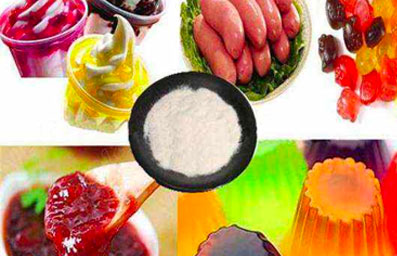
Due to the variety, origin, viscosity coefficient, and production process of thickeners, there may be significant differences in their specific application results. The technical cooperation between thickener manufacturers and food manufacturers is an inevitable trend in the current professional division of labor in the food industry, providing targeted models and process conditions for different users. Another development trend of thickeners is that, in addition to serving as a stabilizing and thickening agent for the system, they are also being developed as a component of functional foods, placing greater emphasis on the functions of polysaccharide compounds.
In the past two years, thickeners have been widely used in the food industry, corresponding products, such as jelly, suspended drinks, fruit juice, fermented milk, liquid milk, soft candy, ice cream, meat products, rice and flour products, bionic food, etc. The viscosity of a thickener solution has a significant impact on its effectiveness, and the factors that affect the viscosity of a thickener are multifaceted. In addition to its structure and relative molecular weight, it also depends on the temperature of the system PH、 Metal ion concentration, shear force, etc. With the increase of thickener concentration, the volume of thickener molecules increases, the probability of interaction increases, and the adsorption of water molecules increases, resulting in an increase in viscosity. The pH of the solution has a significant impact on the viscosity and stability of thickeners, and attention must be paid when selecting and using thickeners. The viscosity of thickeners usually varies with changes in pH value. In addition, as the temperature increases, the speed of molecular motion accelerates and the viscosity of the general solution decreases. The dispersion and dissolution of thickener particles also affect their application characteristics, and the chemical structure of hydrophilic colloidal molecules directly affects their solubility.
After entering the year 2000, the production and processing of food thickeners in China have developed rapidly. Microbial polysaccharides have broken through foreign technology barriers with the sharp increase in xanthan gum production. Zhejiang Tianwei Biochemical Engineering Co., Ltd. was the first to develop and produce gellan gum. Currently, the quality of domestically produced gellan gum has greatly improved, and its excellent cost-effectiveness has won the favor of domestic and Asian food enterprises, expanding its application fields. In recent years, Kerenan gum and pullulan polysaccharide have been continuously introduced, with production capacity increasing from small to large and product varieties increasing day by day. As a major producer of food additives, China's continuous introduction of high-tech products has been targeted by international food ingredient giants. In the past two to three years, many domestic product manufacturers have been acquired and restructured by foreign companies, and the development prospects of products such as xanthan gum, gellan gum, pectin, etc. are worrying.
At present, the industry is facing three main problems: firstly, in the process of strengthening the supervision of food safety by the government, there are still problems such as incomplete regulatory standards and insufficiently scientific law enforcement, which limit the technological innovation of enterprises and bring some adverse effects to their production and operation; Secondly, various cost increases have compressed the profit margin of enterprises, resulting in a decline in their profitability; Thirdly, some products blindly expand production capacity, leading to more intense market competition. The vicious competition of low prices disrupts market order and affects the healthy development of the industry.



 Tel:
Tel:
 Phone:
 Email:
 Addr:
Addr:
 Follow: